In 2011, in one of the projects of the Latvian Fund for Nature, which was dedicated to the study of white-tailed eagles and ospreys, the idea arose to install live cameras near the nests. Installing cameras near nests or animal trails is a widely used method of nature research in the world, but live cameras were not yet known to the general public of Latvia at that time.

Every season, the Latvian Fund for Nature provides about ten live broadcasts from the nests of various birds, in recent years – also an underwater live broadcast from the fish way. Bird livestreams have gained a lot of popularity in the community and have an average of 5 million views from all over the world every year.

Live broadcasts of Latvian birds allow you to look into a bird’s nest in close proximity and in high quality, thus allowing people to get to know the natural processes. Our live broadcasts are also internationally appreciated and have repeatedly come to the attention of foreign media.

It should be emphasized that we do not interfere with natural processes, so unpleasant scenes can also be observed during live broadcasts.

Live bird shows are made possible by donations from viewers. 4G internet is provided by LMT.

Donate for nature conservation

Lesser spotted eagle Clanga pomarina nest in a birch tree

https://youtube.com/live/bGX_D6xY0BM
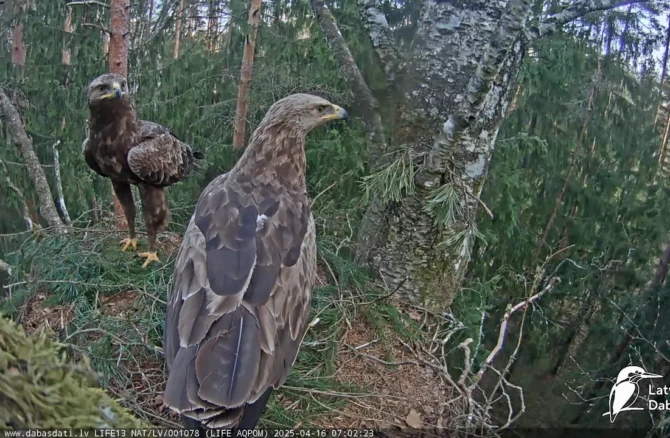
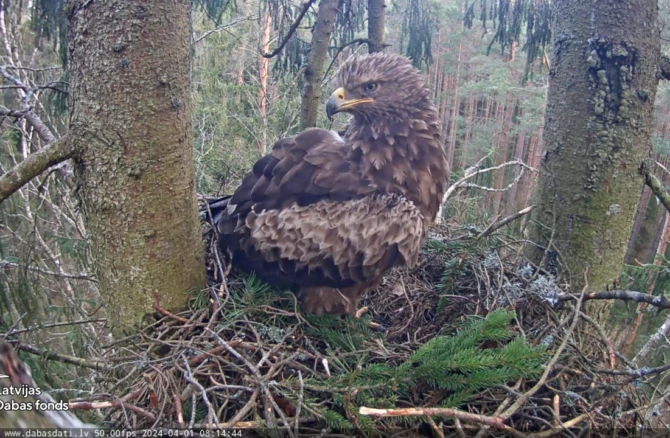
Live streaming is expected to resume in the spring season.   The Lesser Spotted Eagle nest visible in the live stream in the Zemgale region has been known since July 2017, when a single juvenile was recorded there. The nest is built in a birch tree at a height of approximately 20 m. Based on the nesting material, it is estimated to be at least five years old, as the lower layers are already partially decomposed. The online camera system at this site was installed in spring 2018. Since then, eagles have been present at the nest every year, and breeding has been successful from 2022 onwards.   In 2025, the Lesser Spotted Eagles Uldis and Laila successfully bred in the birch nest for the fourth consecutive season, successfully raising one offspring, named Grieta.   The camera system at this nest was installed by Jānis Ķuze and Jānis Rudzītis, with maintenance support provided by Valdis Lukjanovs and Ģirts Strazdiņš within the framework of the Latvian Fund for Nature project “Ensuring the Conservation of the Lesser Spotted Eagle in Latvia” (LIFE AQPOM), which was financially supported by the European Commission’s LIFE+ programme and co-financed by the administration of the Latvian Environmental Protection Fund.   In Latvia, the Osprey (Pandion haliaetus) is included in the list of specially protected species. Nests are built mainly in spruces and birches, and less often in oaks, aspens, and black alders. The main prey consists of rodents and frogs, with moles and ground-nesting birds taken less frequently.   Latvia hosts the most significant Lesser spotted eagle populations — approximately 4,300 pairs, representing 20 % of the global population. However, short-term changes in population size and breeding success are negative. The main factors are reduced food availability, decreased area and quality of breeding habitats, and hunting of birds during migration in the Black Sea and Mediterranean regions. Clutch size is usually 1–2 eggs. More information about the species can be found here.    …

The white-tailed eagle (Haliaeetus albicilla)

Durbe county
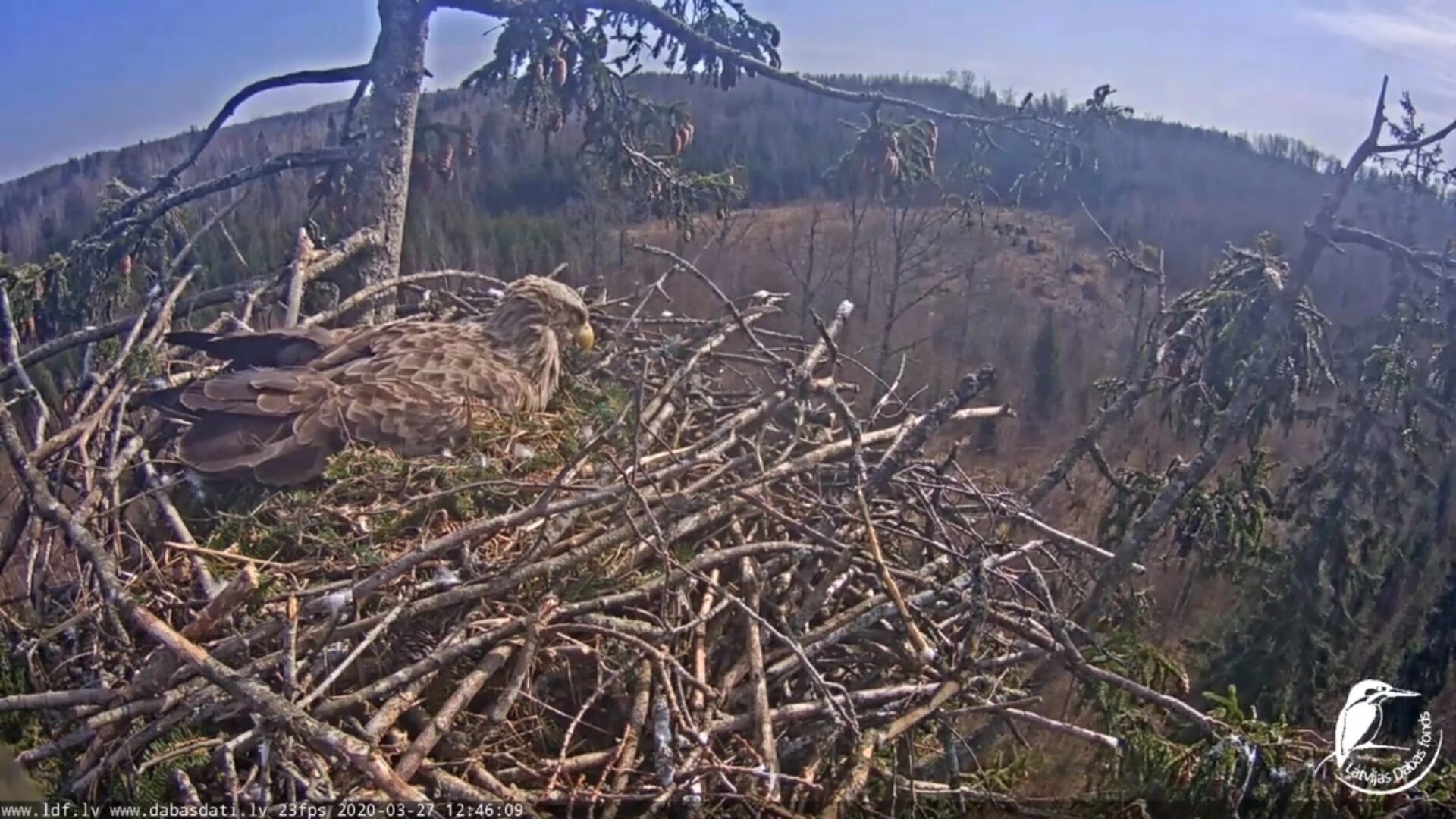
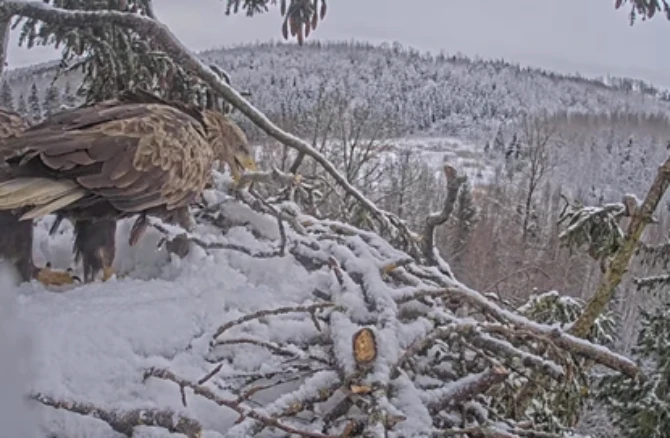
The White-tailed Eagle (Haliaeetus albicilla) nest has been available for online observation on the Dabasdati portal since 2013; more information on the breeding history can be found here.  The nest observed by the camera is located in Kurzeme, near Durbe.  This nest is one of the most-watched – in 2025 it received the highest number of views, totaling 2.8 million. Since 2017, the well-known female Milda has been occupying the nest. Milda’s partner since last year is the male Zorro (Zoris). In 2025, the pair successfully raised two chicks, named Leo and Neo.  The nest can be observed via live stream year-round, as White-tailed Eagles occasionally visit it outside the breeding season. In addition, other visiting birds can also be observed at the nest.  This breeding territory has been known since 2014, when the first nest was discovered, built in a pine tree left in a clear-cut area.  In 2015, the eagles decided to move to a new nest and began building it in the top of a nearby old spruce, which had been broken by wind or snow.  Several branches surrounding the broken top formed a suitable base for nest construction at approximately 25 meters above the ground. The camera was installed on one of the top branches at the end of January, when nest construction had just begun, providing a rare opportunity to observe the process of building a new nest – until then, cameras had mostly been placed on nests that had been occupied for several years. The highest known sea eagle nest in Latvia is located in Ķemeri National Park, 31.5 meters above the ground, and is also built in a spruce tree.

The Black kite (Milvus migrans) nest Kurzeme

Kurzeme
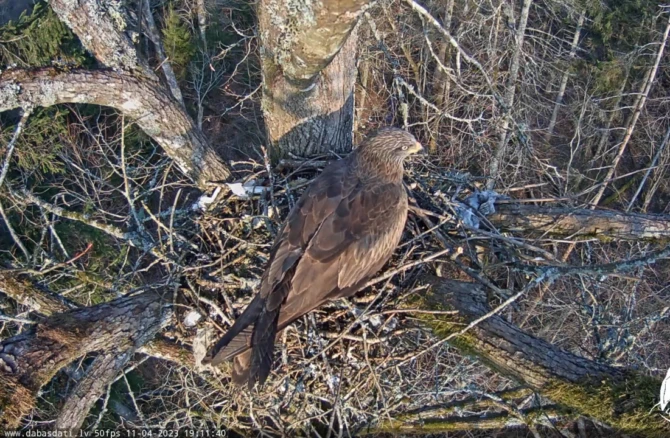
The live stream will return in spring.  The Black kite (Milvus migrans) nest has been available for online observation on the Dabasdati portal since 2020; more information on its breeding history can be found here.  The nest is located within a known Black Kite breeding territory, monitored since 2011.  At the beginning of April 2025, the territory’s resident female, Golda, returned to the nest; however, the new occupants – a pair of Common Buzzards (Buteo buteo) – displaced her. Between 19 and 24 May, three Common Buzzard chicks hatched. Two survived and were named Pēcis and Bose. In July, both successfully fledged and made their first flights.  Previously, the Black Kite had nested in three other nests, two of which were monitored with live-stream cameras (in a birch tree in 2020, 2021, and 2022, and in a linden tree in 2023). The linden nest collapsed during the winter of 2023/2024. In 2024, the breeding site was unknown; later that autumn, a partially built nest was discovered in a maple tree within the previously known territory. At the beginning of 2025, the live-stream system was installed at this new nest.  As is typical for kites, the nest is richly decorated with human-made “ornaments” – plastic sheets, rags, and pieces of string. Pieces of plastic sheets can also be found on the ground beneath the nest.  The camera system was installed by Jānis Ķuze and Jānis Rudzītis, with participation from Pēteris Daknis, Aleksejs Šarīpins, and Renāte Kviese.  The Common Buzzard (Buteo buteo) occurs in Europe and Asia. About 75% of the global population breeds in Europe, making it one of the three most common raptor species on the continent. Clutch size is 1–4 eggs. In Latvia, it is a breeding, passage, and wintering species. Its diet primarily consists of small mammals, mainly rodents. Invertebrates – large insects and earthworms – as well as reptiles (lizards and snakes) and amphibians may also be important in its diet. Occasionally, particularly in winter, it feeds on carrion. More information about Common Buzzards can be found here.  The Common Buzzard (Buteo buteo) Photo: Dabasdati.lv Forum The Black Kite (Milvus migrans) occurs in Europe, North Africa, Asia, and Australia. The species is included in Latvia’s list of specially protected species. It feeds mainly on dead fish and small aquatic animals, and occasionally on carrion. Nests are built in trees of various species. Lining material often includes paper,…

The Black stork (Ciconia nigra) pine tree Rigas Meži

Rīgas meži
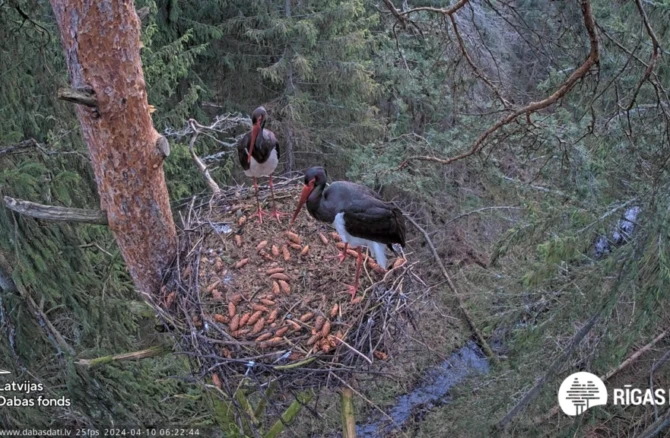
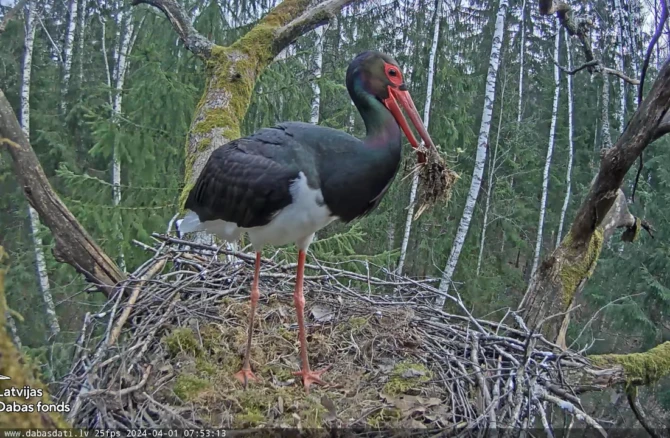
Live streaming is expected to resume in the spring season.   The black stork nest has been available for online observation on the Dabasdati portal since 2015; more information on the events can be found here.  According to information available to Māris Strazds, the location of this nest has been known since 2003. Based on its size and other characteristics, the original nest is estimated to have been built in 2001. Since 2006, the nest has been inspected almost every year.  Chicks were present in 2006, 2007, 2008, 2009, 2011, 2015, 2018, 2020, 2021, 2022, and 2023; however, a relatively large proportion of them died (from starvation) either near the nest or in the nest itself. The main reason is the high density of drainage ditches in the surrounding area, which, depending on winter and spring conditions, can create a misleading impression for storks that food resources will be abundant. During the breeding season, conditions may change very rapidly, resulting in insufficient food for feeding the chicks. Successful breeding is known with certainty for 2011, as one juvenile from that year was recorded in the area in 2019, when the natural nest had already collapsed.  Camera traps that were installed at this nest site for several years have also recorded a bird ringed in Lithuania (a young female). In early February 2020, after the original nest had fallen, an artificial nest platform was constructed at the same location (and height) as the natural nest—14.3 m above ground—by Jānis Ķuze, Māris Strazds, and SIA “Rīgas meži” forest ranger Oskars Taupmanis.  The live-streaming system at the nest was established in early 2024 by J. Ķuze and Jānis Rudzītis, with the participation of representatives of SIA “Rīgas meži,” Edmunds Račinskis and O. Taupmanis. During the first streaming season, black storks visited the nest; however, a stable pair did not form and breeding was not initiated.  In 2025, similarly to 2024, a single bird intermittently occupied the nest, but breeding did not occur.  The estimated population size in Latvia is 85–140 breeding pairs. The primary diet of the black stork consists of fish, but it also feeds on amphibians and other small animals. …

The common kestrel (Falco tinnunculus)

Vicinity of Skrīveri
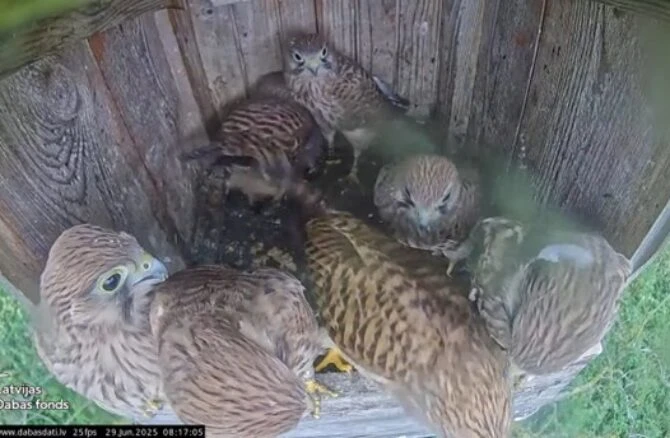
Live streaming is expected to resume in the spring season.  The nest box is located in Krape Parish, Ogre Municipality, and was installed in January 2021 on an aspen tree at a height of approximately eight metres. This  nest has been available for online observation since 2024; further information can be found here. During the first two years it remained unoccupied; however, in 2023 a pair of Eurasian kestrels (Falco tinnunculus) bred successfully in the box, fledging five chicks. The live-stream camera system was established in early 2024. In the first year of live broadcasting, the kestrels fledged four young. In 2025, kestrels again bred successfully in the box, fledging six young birds.  Breeding of Eurasian kestrels in an old raven nest located on a high-voltage power line pylon was first recorded by Imants Jakovļevs in 2002 while collecting data for the second Latvian Breeding Bird Atlas. Breeding on high-voltage power lines in the Skrīveri, Aizkraukle, and Lielvārde areas was also observed in subsequent years. Following an article by Aigars Kalvāns published in 2014 in the Latvian Ornithological Society journal Putni dabā, which described kestrel breeding in nest boxes in the Liepāja region, Imants Jakovļevs installed the first Eurasian kestrel nest box in Skrīveri Parish. By 2018, ten nest boxes had been installed, and in 2020 the first box was occupied; later that season, six kestrel chicks fledged from it.  At present, a total of 20 nest boxes intended for Eurasian kestrels have been installed in Krape, Lielvārde, Lēdmane, and Jumprava parishes of Ogre Municipality, and in Aizkraukle and Skrīveri parishes of Aizkraukle Municipality. In 2023, kestrels bred successfully in eight of these boxes. Occasionally, tawny owls (Strix aluco) and long-eared owls (Asio otus) also nest in boxes intended for this species.  The camera system was designed and installed by Jānis Rudzītis, Imants Jakovļevs, and Jānis Ķuze.  The Eurasian kestrel is a short-distance Winter migrants in Western Europe and returns to Latvia in late March. Clutch size typically ranges from three to eight eggs, which are incubated for approximately 28 days. Egg-laying usually occurs from late April to late May. The species feeds mainly on small rodents (mice and voles), lizards, large insects such as beetles and dragonflies, and other small animals. More information about birds of falconiform birds can be found here. …

The Eurasian goshawk (Accipiter gentilis), in CCUH territory, nest 1

Rīga
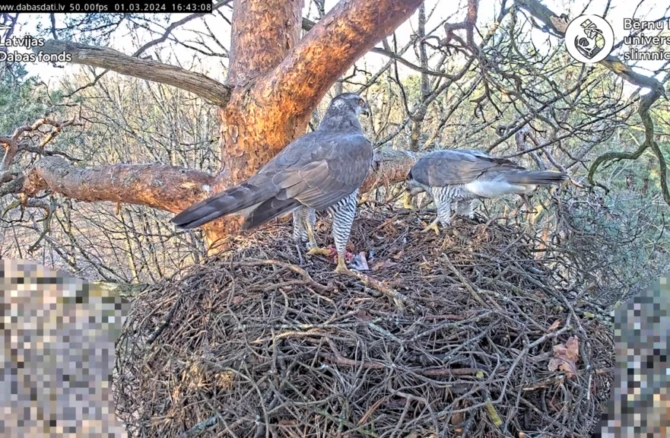
Live streaming is expected to resume in the spring season. The nest can be observed online on the Dabasdati portal since 2024; more information on the breeding history can be found here.  Breeding of the Eurasian goshawk (Accipiter gentilis) within the territory of the Children’s Clinical University Hospital (VSIA “Bērnu klīniskā universitātes slimnīca”) has been known since 2015. Currently, two goshawk nests are located relatively close to each other within the hospital grounds; both are in good condition, while…

The Black stork (Ciconia nigra) oak tree

Ogre county
Live streaming is expected to resume in the spring season.  This black stork nest has been available for online observation since 2023; further information can be found here.  According to information available to Māris Strazds, the black stork breeding territory in this area has been known since at least 2003; however, this particular nest was discovered only in 2021.  In 2024, black storks bred successfully, and four young ringed birds fledged from the nest.  In 2025, the male, named Ogris, returned to the nest on April 17. Although the female began visiting the nest later, this occurred too late in the season and breeding was not initiated.  The live-stream camera at this nest was installed in early 2023 by Jānis Ķuze and Jānis Rudzītis.  In Latvia, the black stork is rare, the species is included in the list of specially protected species. Population estimate in Latvia 85-140 pairs. The main food of the black…

The osprey (Pandion haliaetus) 

Kurzeme
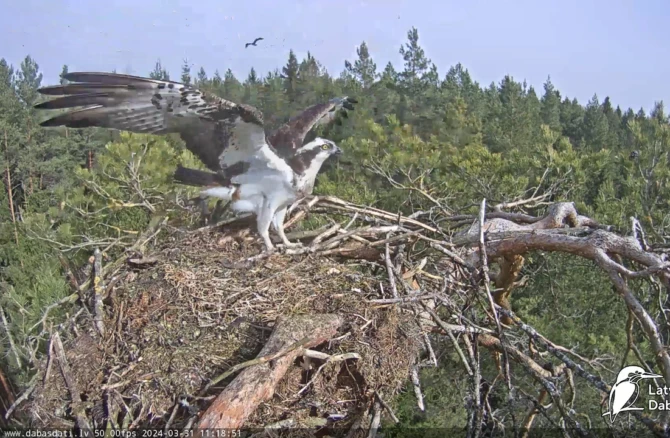
Live streaming is expected to resume in the spring season.  Osprey Pandion haliaetus online monitoring of the nest on the Dabasdati portal has been available since 2012; more information on the breeding history can be found here.  The nest under observation is located in Kurzeme (western Latvia). According to information provided by Aigars Kalvāns, the nest site has been known since 2004. The nest is built in the branching of a drooping limb of an old pine tree. From 2007 to 2023, the nest was occupied every year; breeding was unsuccessful only in 2007, 2010, and 2019. In all other years, one to three young ospreys fledged from the nest.  In 2025, the pair from the previous year, Selga and Svings, returned to the nest and successfully raised onechick. The young bird was named Gaida.  In Latvia, the Osprey (Pandion haliaetus) is a rare species and is included in the list of specially protected species. The breeding population in Latvia is 220–230 pairs. Its primary diet consists of fish. Ospreys most often build nests in old pine trees with rounded crowns or in spruces with broken tops, typically at distances of 3–5 km from water bodies. Clutch size ranges from two to four eggs. More information about the osprey can be found here. …

The lesser spotted eagle (Clanga pomarina)

Zemgale
The live stream will return in spring.  Online monitoring of the nest on the Dabasdati portal has been available since 2018; more information on the breeding history can be found here.  The nest visible during the live-streaming season is located on the western edge of the Zemgale region. It was discovered in 2018. The nest is built in a spruce tree at a height of 17 m, securely placed in a stable fork formed by three main branches. Based on its position, it can be considered a typical nest of the Lesser Spotted Eagle (Clanga pomarina): approximately half of all nests of this species in Latvia are located in spruces, and many are built in similar locations where, at the point of trunk breakage, branches have formed several new leaders. Judging by the nest dimensions and the condition of the nesting material, the nest was at least five years old at the time of its discovery.  In 2025, Lesser Spotted Eagles Anna and Andris bred successfully in the spruce nest for the seventh consecutive season, successfully raising one offspring, named Reinis.  The camera system at this nest was installed by Jānis Ķuze and Jānis Rudzītis, with additional assistance in maintenance provided by Valdis Lukjanovs and Ģirts Strazdiņš. We thank Jānis Kažotnieks and Renāte Kviese for their support.  In Latvia, the Osprey (Pandion haliaetus) is included in the list of specially protected species. Nests are built mainly in spruces and birches, and less often in oaks, aspens, and black alders. The main prey consists of rodents and frogs, with moles and ground-nesting birds taken less frequently.  Latvia hosts the most significant Osprey populations — approximately 4,300 pairs, representing 20 % of the global population. However, short-term changes in population size and breeding success are negative. The main factors are reduced food availability, decreased area and quality of breeding habitats, and hunting of birds during migration in the Black Sea and Mediterranean regions. Clutch size is usually 1–2 eggs.  More information about the species can be found here. …